Dealers of used Leica gear don't come up easily with Google searches, so I've compiled a list. Andrew Nemeth has a list, but some links are defunct and it leaves off some great sites.
So here is my list for places to buy a used Leica or other classic cameras (US Sellers):
Rangefinderforum Classifieds - Where most Leica users go to sell their gear. It is well laid out and easy to navigate. Users tend to sell at the most competitive prices
Collectible Cameras - A wide variety of Leicas and probably the 2nd largest overall used site behind keh. It also offers some of the better dealer prices.
Igor's Camera Exchange - Igor has a wide variety of Leicas. I think he has the best prices of any dealer.
Classic Connection - A third major dealer has a wide variety at very good prices.
Keh - The largest used camera store has a good selection of Leicas, but they are noticeably higher priced than the above three dealers
George Ury - Has a moderate selection at good prices (better than keh)
Tamarkin - Has a modest selection. (comparable to keh)
Koh's Camera - Has a smaller selection that tend towards collectible rather than user cameras.
Manfred Schmidt - Wide variety of camera choices, but prices are high (higher than keh)
Adorama - The camera superstore also has a substantial used section at competitive prices (slightly better than keh).
B&H Photo -Adorama's main competitor, it usually has a smaller used section than Adorama, but prices are competitive.
Sherry Krauter - The repair guru (who I heartily recommend), has modest selection at varying prices (some seem to be close to market, others much higher)
The following are small stores with small inventories, but worth checking if needed
Bergen County Camera - Smaller selection, but reasonably priced
Pacific Rim Cameras - Better site for camera info. Some cameras for sale, but at a high premium
Kenmore Camera - Small selection, good prices
Jack's Camera - Small selection, if any
Wing's Camera - Tiny selection
Brooklyn Camera - Tiny selection
Tuesday, January 11, 2011

Thursday, November 4, 2010
In Kodachrome: Baby Animals at the Texas State Fair
Well how about I actually post some photos for a change. These are baby animals at the Texas State Fair. All photos taken with my Voigtlander Bessa R3a, Voigtlander Nokton 50mm f/1.5, on Kodachrome 64. I have 2 months to shoot my remaining 3 rolls of Kodachrome 64.
Baby Zebra

Shetland Pony:

Baby Goat:

Baby Kangaroo

A 1200 lb pig:

The little farm kids showing their animals:

Baby Camels:

Baby Goats:

Fuzzy Llama:

Baby Zebra
Shetland Pony:
Baby Goat:
Baby Kangaroo
A 1200 lb pig:
The little farm kids showing their animals:
Baby Camels:
Baby Goats:
Fuzzy Llama:
Saturday, October 23, 2010
Ansco B2 Speedex Review & Results
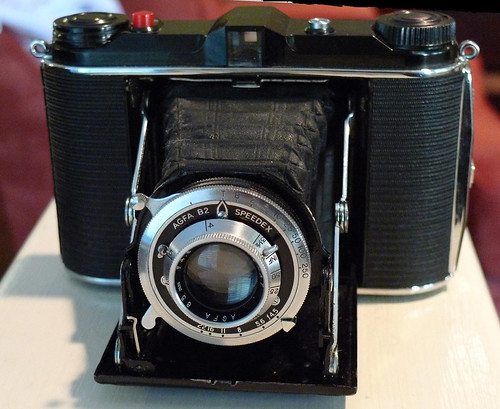
The B2 Speedex was made in Binghamton, New York by Agfa Ansco. It is very similar to early Agfa Isolette cameras and it was made around 1940. "B2" is what Agfa called 120 film back in the day.
Shutter: It has an unmarked shutter, which features shutter speeds of B, T, 2, 5, 10, 25, 50, 100, 250. It is rather uncommon for a shutter not to be separately marked. Common shutters were Vario, Klio , Prontor, and Compur. The earlier Compur shutter had the same shutter speeds as this Speedex.
Lens: The 85mm f/4.5 Agfa Anastigmat lens is also a bit of a mystery. Agfa marketed the Agnar (3 element), Apotar (better 3 element) and Solinar (4 element). I've seen a very similar looking Isolette on eBay with a 85mm f/4.5 Solinar lens. Cheaper leneses were normally attached to cheaper shutters, so it can't be the bottom level lens. However, "Anastigmat" is normally a label I see attached to three element lenses. (he agrees: What the Heck is an Anastigmat). My guess is that is like an Apotar.
Operation: Body shutter, which I like. No double exposure prevention which I like. No depth of field scale, which I find especially annoying on a scale focus camera. Like most folders, you have to look through the little red window when advancing film.
Condition and Repairs: The bellows, like all Agfa folders, were full of pinhole leaks. Some of these are hard to see without a very powerful flashlight. I first attempted to patch the bellows with some RTV black silicone. This is a good solution for a bellows with a couple of holes, but these bellows were littered with pinholes, so I decided to replace the bellows. I bought the new bellows from Workmans Photography. The slow speeds (2, 5) stick, but I don't plan on doing anything about it.The lens has a few internal spots, so I'd give a 7.5/10 rating.
Camera (with the old bellows):

Results:
The results are quite positive, but it can be difficult to guess distances. It's not too bad at f/16 due to the wide depth of field, but I wouldn't want to try at f/4.5 except at infiniti. I expected the camera to perform well at f/8-f/16, but I didn't really have an opportunity for a test a f/4.5, so until next roll.
At f/8. No flash sync, so I manually tripped the flash, with the shutter open. Notice the black in the lower right. That's because of my B+ job in replacing the bellows. That piece stuck into the frame.It is on all photos, just cropped out of others.

At f/16, 6.5 feet:
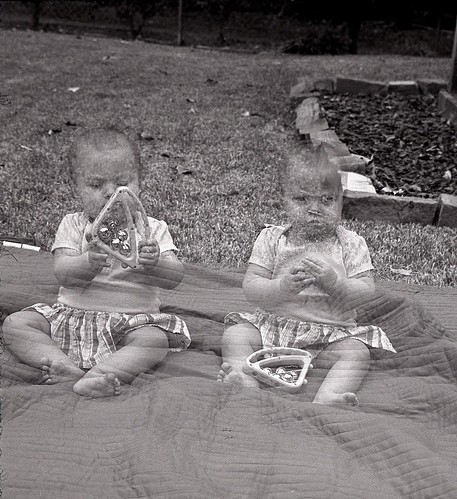
Double exposure at: f/22 Double exposures are easy, because all you have to do is recock the shutter. Camera manufacturer's later added mechanisms that prevents double exposure. This was for the benefit of most consumers at the time, but it prevents experimentation today.

Shutter: It has an unmarked shutter, which features shutter speeds of B, T, 2, 5, 10, 25, 50, 100, 250. It is rather uncommon for a shutter not to be separately marked. Common shutters were Vario, Klio , Prontor, and Compur. The earlier Compur shutter had the same shutter speeds as this Speedex.
Lens: The 85mm f/4.5 Agfa Anastigmat lens is also a bit of a mystery. Agfa marketed the Agnar (3 element), Apotar (better 3 element) and Solinar (4 element). I've seen a very similar looking Isolette on eBay with a 85mm f/4.5 Solinar lens. Cheaper leneses were normally attached to cheaper shutters, so it can't be the bottom level lens. However, "Anastigmat" is normally a label I see attached to three element lenses. (he agrees: What the Heck is an Anastigmat). My guess is that is like an Apotar.
Operation: Body shutter, which I like. No double exposure prevention which I like. No depth of field scale, which I find especially annoying on a scale focus camera. Like most folders, you have to look through the little red window when advancing film.
Condition and Repairs: The bellows, like all Agfa folders, were full of pinhole leaks. Some of these are hard to see without a very powerful flashlight. I first attempted to patch the bellows with some RTV black silicone. This is a good solution for a bellows with a couple of holes, but these bellows were littered with pinholes, so I decided to replace the bellows. I bought the new bellows from Workmans Photography. The slow speeds (2, 5) stick, but I don't plan on doing anything about it.The lens has a few internal spots, so I'd give a 7.5/10 rating.
Camera (with the old bellows):
Results:
The results are quite positive, but it can be difficult to guess distances. It's not too bad at f/16 due to the wide depth of field, but I wouldn't want to try at f/4.5 except at infiniti. I expected the camera to perform well at f/8-f/16, but I didn't really have an opportunity for a test a f/4.5, so until next roll.
At f/8. No flash sync, so I manually tripped the flash, with the shutter open. Notice the black in the lower right. That's because of my B+ job in replacing the bellows. That piece stuck into the frame.It is on all photos, just cropped out of others.

At f/16, 6.5 feet:
Double exposure at: f/22 Double exposures are easy, because all you have to do is recock the shutter. Camera manufacturer's later added mechanisms that prevents double exposure. This was for the benefit of most consumers at the time, but it prevents experimentation today.
Friday, October 22, 2010
Medium Format Folders
Why Own?
I find something intriguing about medium format folding cameras. I think it is due to the combination of larger MF negatives, pocketability, simplicity, and relatively low cost. Medium format folding cameras were popular from the 1930s to the 1950s.
If someone doesn't own a medium format camera, they are cheap way to get into it. Compared to a Lomo camera, even the simplest folders have a triplet lens (versus single element plastic lenses), 3 more shutter speeds, and an adjustable aperature that is 2-3 stops faster at its widest.
What Drives Price

Manufacturers:
Zeiss Ikonta 524/2: It's a 6x9 from the early-mid 1950s, with a Synchro-Compur shutter and a coated 105/3.5 Tessar lens, and an uncoupled rangefinder. I upgrade to this from the very capable Ikonta 523/2 (added the uncoupled rangefinder).

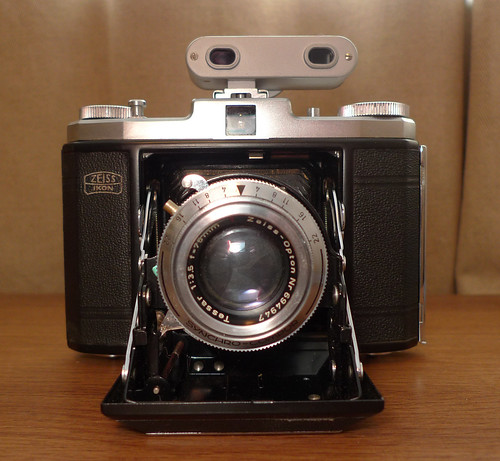
Zeiss Ikonta 523/16 with a Synchro-Compur shutter and a 75/3.5 Tessar lens.

Ansco Speedex B2. This is a 6x6 from about 1940, with an uncoated Agfa (triplet) 85/4.5 lens with an unnamed shutter, but it has 7 speeds, similar to a Compur.
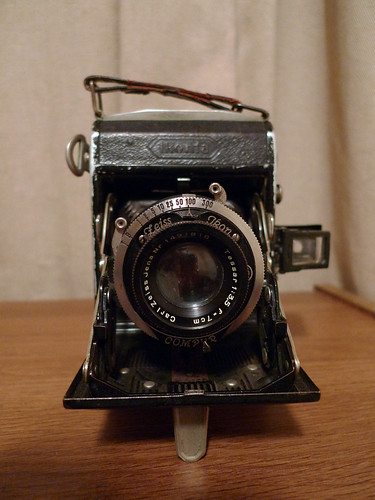
Zeiss Ikonta 520 A. It is a 6x4.5 camera from 1933 or 1934. It has an uncoated 70/3.5 Tessar with a Compur shutter

Links
Price List - Post 1950, Zeiss Ikon 120 Folders
Zeiss Ikonta 523/2 Reviewed
Zeiss Ikonta 524/2 Reviewed
Agfa Ansco B2 Speedex Reviewed
I find something intriguing about medium format folding cameras. I think it is due to the combination of larger MF negatives, pocketability, simplicity, and relatively low cost. Medium format folding cameras were popular from the 1930s to the 1950s.
If someone doesn't own a medium format camera, they are cheap way to get into it. Compared to a Lomo camera, even the simplest folders have a triplet lens (versus single element plastic lenses), 3 more shutter speeds, and an adjustable aperature that is 2-3 stops faster at its widest.
What Drives Price
Camera collectors can radically change the price of seemingly similar cameras. However, there are distinct differences that can change the price from $10 to $400.
- Number of lens elements: Cameras with 4-element lenses such Zeiss Tessar, Voigtlander Skopar, or Agfa Solinar command substantial premiums. Most folders tend to have lenses that are in the style of a Cooke Triplet, such Agnar, Apotar, Voigtar, Vaskar, Novar, Nettar, or Radionar. They often have the word Anastigmat after the name. They are not bad lenses and offer similar performance at apertures f/8 and smaller. Voigtlander equipped some of its folders with 5 element Heliar lenses - very expensive
- Lens coating: Post-war lenses are coated which helps reduce flare and increase contrast. This is nice feature, but it doesn't mean uncoated lenses are dogs. To the collector, a coated 4 element lens command a significant premium.
- Shutter: Better shutter offer more shutter speeds and flash synchronization. The grand poobah of shutters is the Synchro-Compur with a top speed of 500 and a flash synchronization. Earlier Compur and Compur Rapid shutter are quality shutters. Prontor made a line of quality shutter that are just behind the Compur is quality, but still highly useable. Vario shutters were some of the simpler shutters with three shutter speed plus bulb. Tempor shutters are East German versions of the Compur. I have difficulty trusting the quality of the Eastern Bloc camera equipment.
- Rangefinder: Rangefinders help focus the camera. Without one, you have to guess the distance to your subject. Rangefinders that can be coupled or uncoupled. With an uncoupled rangefinder, you use the rangefinder to determine the distance, then manually set the distance on the focussing ring. There are few folders with coupled rangefinders and these command the highest prices. Models with uncoupled rangefinders also command premiums.
- Condition: Besides cosmetic condition, old cameras can get problems: Slow speeds on the shutters can stick, lenses can get cloudy or get fungus. One of the prime areas where folders can get problems is their bellows. Almost every Agfa or Ansco model needs new bellows because the material they used was subpar. They develop pinhole leaks, so you can see by plain visual inspection. I shine a high powered flashlight into the back of the camera.
- Format: Folders that use 120 film shoot one of three formats: 6x4.5, 6x6, 6x9. Price doesn't vary greatly between models, but 6x6 format is the most common, so the most bargain finds will be here.
- Oddities: Collectors go for various ancillary things that have no bearing on how a camera performs, such as the original box, or a MIOJ stamp (Made in Occupied Japan),.
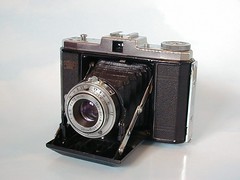
If I had to recommend one for someone looking for a folder without wanting to commit much money, it would be one of the post-war Zeiss Nettar. Zeiss has the best reputation for build quality and their bellows are typically still light tight.. They typically go for $20-$25. Zeiss had a million different models, so a picture is worth 1,000 words:
Manufacturers:
- Zeiss made a full line of Nettar and Ikonta models starting in the early 1930s.
- Agfa made a range of Isolette cameras. Ansco had a JV with Agfa and had nearly identical cameras branded Speedex.
- Welta is less known but made good cameras. The Perle is 645 and the Weltax is a 6x6. The Weltur came in 6x9 or 6x6 versions. The big advantage is that it is unit focusing, means that the whole lens moves to focus, not just the front element which is common to most folders.
- Voigtlander was another major manufacturer. Perkeo was the 6x6 and the Bessa is a 6x9. There was also a Bessa 6x6.
- Certa, Balda, Ensign, Franka, and Dacora were other European companies that made reasonably quality folding cameras
- Kodak made a lot of folding cameras, but Kodak has a reputation for making junky cameras, withstanding their Retina line (which was made by Nagel). A lot of Kodak folding cameras also use film that is no longer available, such as 620 or 116.
Zeiss Ikonta 524/2: It's a 6x9 from the early-mid 1950s, with a Synchro-Compur shutter and a coated 105/3.5 Tessar lens, and an uncoupled rangefinder. I upgrade to this from the very capable Ikonta 523/2 (added the uncoupled rangefinder).
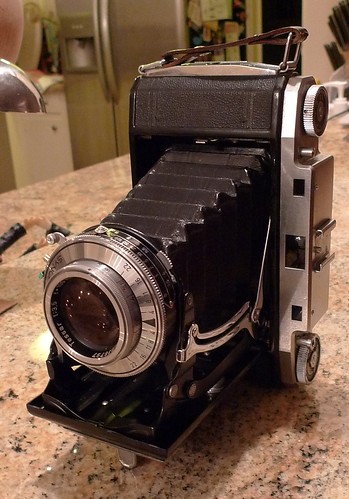
Zeiss Ikonta 523/16 with a Synchro-Compur shutter and a 75/3.5 Tessar lens.
Ansco Speedex B2. This is a 6x6 from about 1940, with an uncoated Agfa (triplet) 85/4.5 lens with an unnamed shutter, but it has 7 speeds, similar to a Compur.
Zeiss Ikonta 520 A. It is a 6x4.5 camera from 1933 or 1934. It has an uncoated 70/3.5 Tessar with a Compur shutter
Links
Price List - Post 1950, Zeiss Ikon 120 Folders
Zeiss Ikonta 523/2 Reviewed
Zeiss Ikonta 524/2 Reviewed
Agfa Ansco B2 Speedex Reviewed
Tuesday, October 12, 2010
TDC Stereo Colorist II Review
The TDC Colorist II:. As other sites will tell you, the TDC Colorist II was made in Germany by Bodensee Kamerawerke for Three Dimension Company, a subsidiary of Bell & Howell.

Pros:
Cons:
Results:
I've only taken two rolls so far, but I've been pleased with the results. It's hard to review the combined results of a stereo image on the net.
The biggest challenge is managing depth of field, but this will be consistent across all stereo cameras. Stereo pictures look best when objects are in focus, and objects are at different depths. If you purely use the rangefinder, it can be hard to have both someone close and background in focus. You can use the rangefinder to determine distance to your subject but then use depth of field scales to increase your total dof. For example, if with the 35mm lens at f/8, if you focus on your subject 7 feet away, you have dof between 5 and 12 feet. If you then change your focus to 12 feet away, your depth of field will be between 7 feet at 40 feet, allowing for greater background sharpness.
Elite Chrome 200:
Both photos at f/16


Below photos are Kodachrome 64.
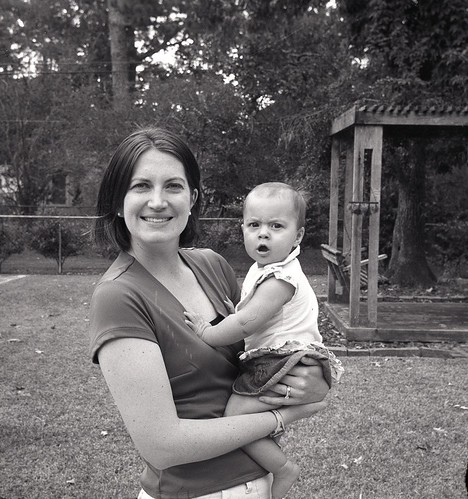
At f/11 or f/16. Ignore the movement of the baby's head, there is a lot of sharp detail:

Probably around f/8:

Probably around f/5.6, with fill flash:

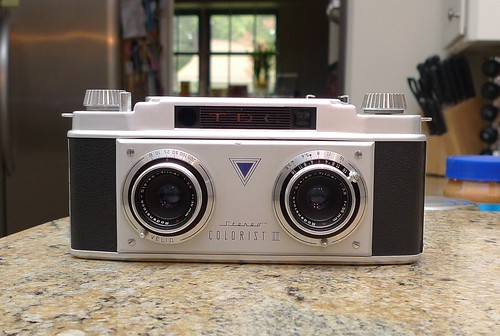
Pros:
- The top viewfinder is natural. Almost every camera on Earth has a viewfinder on top of the camera, except the Stereo Realist, which has a bottom viewfinder which is awkward to use.
- While the viewfinder is small by today's standards, it's acceptable. There isn't much difference from one 50s era stereo camera to the other, regarding the size of the viewfinder
- The focus, shutter speed and aperature are in logical places. I can focus the camera easily when holding it up to take photo.
- Focusing is easy because the RF patch is big and visible.
- It has a standard hot shoe, which allows for easy use of flash
- The camera has 35mm f/3.5 Rodenstock Trinar lenses. It produces very sharp results stopped down and good results at wider apertures. However the benefits of stereo come into play with a when the whole image is in focus, so performance at wider apertures is less relevant.
Cons:
- The body seems combersome to hold, because of its thickness.
- You need to have film in the camera (or manually wind the sprockets to the left of the takeup spool) in order to wind the shutter.
Results:
I've only taken two rolls so far, but I've been pleased with the results. It's hard to review the combined results of a stereo image on the net.
The biggest challenge is managing depth of field, but this will be consistent across all stereo cameras. Stereo pictures look best when objects are in focus, and objects are at different depths. If you purely use the rangefinder, it can be hard to have both someone close and background in focus. You can use the rangefinder to determine distance to your subject but then use depth of field scales to increase your total dof. For example, if with the 35mm lens at f/8, if you focus on your subject 7 feet away, you have dof between 5 and 12 feet. If you then change your focus to 12 feet away, your depth of field will be between 7 feet at 40 feet, allowing for greater background sharpness.
Elite Chrome 200:
Both photos at f/16


Below photos are Kodachrome 64.
At f/11 or f/16. Ignore the movement of the baby's head, there is a lot of sharp detail:
Probably around f/8:
Probably around f/5.6, with fill flash:
Monday, July 19, 2010
Stereo Cameras
There seems to be a serious lack of information on stereo cameras on the internet. There is a lot of technical information available, but little discussion about the pros and cons each and how most cameras have held up over time.
Here are some sites that are out there already:
Stereoscopy.com has a lot of technical information, but no opinions or discussion about pros and cons.
Photo-3d.com has pictures but no reviews.
This site discusses different types of stereo photography. I am focused on a twin lens camera.
This site has a few reviews, though the picture links are broken.
The Rise of the Stereo Realist - is in the mold of the type of site I was looking for.
Here is what I've been able to learn:
Based on what I've seen, I've narrowed it down to the Revere 33 or the Colorist II. Both have 35/3.5, 3 element Cooke-triplet lenses: Revere's Wollensack Amaton and the Colorist's Rodenstock Trinar lenses. I'm not sure if one is better than the other. Both were good brands.
Here are some sites that are out there already:
Stereoscopy.com has a lot of technical information, but no opinions or discussion about pros and cons.
Photo-3d.com has pictures but no reviews.
This site discusses different types of stereo photography. I am focused on a twin lens camera.
This site has a few reviews, though the picture links are broken.
The Rise of the Stereo Realist - is in the mold of the type of site I was looking for.
Here is what I've been able to learn:
- Kodak Stereo - Most have shutter problems - the speeds stick and even when working the two shutters can fire at different speeds, producing
- Realist 3.5 - This I've actually held. Seems ergonomically weird. The viewfinder is on the bottom, the focus dial is on the side and the shutter release is on the top. The Realist 2.8 was essentially the same camera with better lenses.
- Realist 45 (or Iloca Stereo Rapid) - Supposedly easy to use but no rangefinder. Bottom viewfinder.
- Revere 33 - Has a bubble level in the viewfinder, but the viewfinder is apparently small and the rangefinder is seperate. Supposedly the hotshoe is "not standard." I've seen it described both as delicate and built like a tank. Perhaps the external is solid, but the internals are delicate?
- Wollensak 10 - A upmarket Revere 33 with top quality lenses.
- Stereo Graphic - Two shutter speeds and fixed focus.
- TDC Colorist II - Normal hotshoe and integrated rangefinder, but no bubble level. Aperture grease can supposedly get gunked up. The Colorist I has no rangefinder.
- Wirgin Stereo (Edixa IA) - No rangefinder and cold shoe. Issues with light leaks have been mentioned.
Based on what I've seen, I've narrowed it down to the Revere 33 or the Colorist II. Both have 35/3.5, 3 element Cooke-triplet lenses: Revere's Wollensack Amaton and the Colorist's Rodenstock Trinar lenses. I'm not sure if one is better than the other. Both were good brands.
Saturday, July 10, 2010
Price List - Post 1950, Zeiss Ikon 120 Folders
I like the Zeiss line of folders because their bellows tend to be still light tight, unlike the Agfa ones. The models below are the later models produced after 1950, where the viewfinder is integral to the top plate: so they all basically look like the photo below. The advantage that these have is that it has an accessory shoe, so you can mount an external rangefinder and/or a light meter.

The body of the cameras are the same, while the difference is the lens/shutter combination. The Novar is a 3-element lens, while the Tessar has 4 elements. All have coated lenses.
Models that have a number XXX/2 are 6x9 format, while XXX/16 are 6x6. I don't know why
Nettar - The least expensive model came with a 4 speed Vario shutter and a Novar f/6.3. Other slightly more expensive models came with a 6 speed Pronto shutter and a Novar f/4.5.
Ikonta and Ikonta M - The Ikonta M had a uncoupled rangefinder, while others are scale focus only. Ikontas with Novars were often places with Prontor-S shutters while Tessars had Compur-Rapid shutters. The primary difference is that the Compur has a top shutter speed of 1/500, while the Prontor has a top speed of 1/250.
The prices are sourced from eBay auctions and Classified sales. One thing to note is that an eBay sale price is the price willing to be paid by the second bidder. If someone bids the $100 and I win with a $150 bid, my sale price is $101, but in actuality, the value of the item is the price I would be willing to pay ($150).
Updated (Nov 2, 2010)
6x9:
Nettar 517/2 with Novar 105/6.3 - $35
Ikonta 523/2 with Novar 105/3.5 - $80
Ikonta 523/2 with Tessar 105/3.5 - $210
Ikonta M 524/2 with Novar 105/3.5 $115-$130
Ikonta M 524/2 with Tessar 105/3.5 - $230 - $420
6x6:
Nettar 517/16 with Novar 75/6.3 - $20-$25
Nettar 518/16 with Novar 75/4.5 - $20-$30
Ikonta 523/16 with Novar 75/3.5 - $50
Ikonta 523/16 with Tessar 75/3.5 - $110
Ikonta M 524/16 with Novar 75/3.5 - $75 - $185
Ikonta M 524/16 with Tessar 75/3.5 - $250
Super Ikonta III (531/16) (6x6 coupled RF) with Novar 75/3.5 - $125-$150
Super Ikonta III (531/16) (6x6 coupled RF) with Tessar 75/3.5 - $275-$300

The body of the cameras are the same, while the difference is the lens/shutter combination. The Novar is a 3-element lens, while the Tessar has 4 elements. All have coated lenses.
Models that have a number XXX/2 are 6x9 format, while XXX/16 are 6x6. I don't know why
Nettar - The least expensive model came with a 4 speed Vario shutter and a Novar f/6.3. Other slightly more expensive models came with a 6 speed Pronto shutter and a Novar f/4.5.
Ikonta and Ikonta M - The Ikonta M had a uncoupled rangefinder, while others are scale focus only. Ikontas with Novars were often places with Prontor-S shutters while Tessars had Compur-Rapid shutters. The primary difference is that the Compur has a top shutter speed of 1/500, while the Prontor has a top speed of 1/250.
The prices are sourced from eBay auctions and Classified sales. One thing to note is that an eBay sale price is the price willing to be paid by the second bidder. If someone bids the $100 and I win with a $150 bid, my sale price is $101, but in actuality, the value of the item is the price I would be willing to pay ($150).
Updated (Nov 2, 2010)
6x9:
Nettar 517/2 with Novar 105/6.3 - $35
Ikonta 523/2 with Novar 105/3.5 - $80
Ikonta 523/2 with Tessar 105/3.5 - $210
Ikonta M 524/2 with Novar 105/3.5 $115-$130
Ikonta M 524/2 with Tessar 105/3.5 - $230 - $420
6x6:
Nettar 517/16 with Novar 75/6.3 - $20-$25
Nettar 518/16 with Novar 75/4.5 - $20-$30
Ikonta 523/16 with Novar 75/3.5 - $50
Ikonta 523/16 with Tessar 75/3.5 - $110
Ikonta M 524/16 with Novar 75/3.5 - $75 - $185
Ikonta M 524/16 with Tessar 75/3.5 - $250
Super Ikonta III (531/16) (6x6 coupled RF) with Novar 75/3.5 - $125-$150
Super Ikonta III (531/16) (6x6 coupled RF) with Tessar 75/3.5 - $275-$300
Subscribe to:
Posts (Atom)